
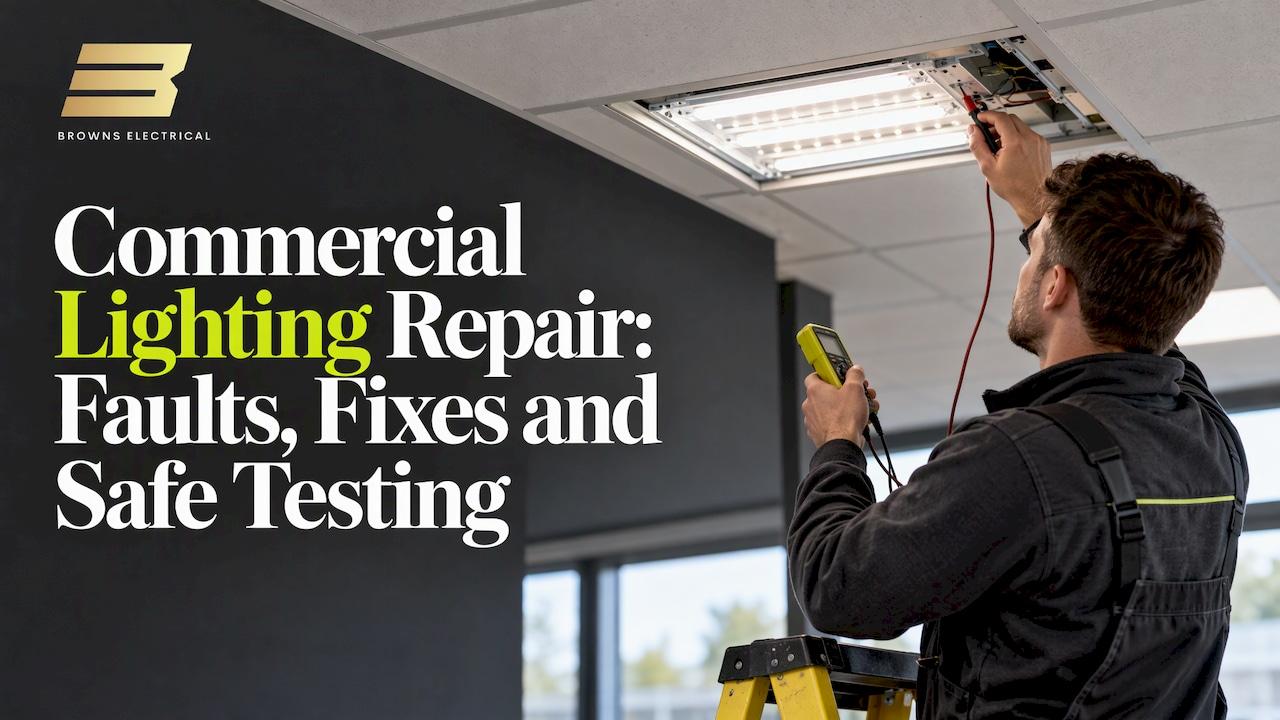
When lights fail in a shop, office, warehouse or workshop, the quickest route back to normal is one electrician who finds the fault, repairs it and certifies the work. At Browns Electrical, the electrician who quotes your job is the one who carries it out. That matters because lighting faults are rarely just a dead lamp. They can be a failed driver, a damaged fitting, a tripped circuit or an emergency lighting system that no longer meets its duty. This guide covers what goes wrong, what a proper repair involves, when repair beats replacement and what the law expects of you as a business.
TL;DR
- Most commercial lighting faults come from a handful of causes: failed lamps, LED drivers, damaged fittings, faulty wiring or controls, and emergency lighting batteries.
- A tripped breaker or blown fuse caused by a fitting should never simply be reset. The cause has to be found and the unit repaired, replaced or taken out of service first.
- Repair makes sense when the fault is in a replaceable part. Replacement, ideally as a planned LED upgrade, makes sense when parts are unobtainable or failures keep returning.
- Emergency lighting is a legal safety duty for most business premises, tested monthly and maintained annually, and the standards changed in 2025.
- Lighting repairs should be carried out by a competent electrician and finished with certification to BS 7671, the UK wiring standard.
Table of Contents
- What counts as a commercial lighting fault
- Why LED fittings fail, and why it is not always the LEDs
- Diagnosing a lighting fault safely
- Repair or replace: how to decide
- What a proper commercial lighting repair includes
- Emergency lighting: the repair you cannot leave on a list
- What affects the cost of a lighting repair
- Who should do the repair
- Getting ahead of the next failure
- FAQ
- Sources
What counts as a commercial lighting fault
Commercial lighting covers more than ceiling lights. It includes panel lights in office grids, high-bay fittings in warehouses, display and retail lighting, external and car park lighting, sensors and controls, and the emergency lighting that keeps escape routes visible when the mains fails.
Faults tend to show up in recognisable ways:
- Flickering or buzzing. Often a failing driver, a loose connection or an incompatible dimmer or control.
- One fitting dead, the rest working. Usually the lamp, the driver or a connection at that fitting.
- A whole row or circuit out. Points to a tripped breaker, a blown fuse, a broken cable or a failed control device.
- Fittings that dim over time with no obvious failure. Typical of ageing LEDs, where output slowly declines rather than the light suddenly going out.
- Emergency lights that fail the monthly test or do not last their full duration. Usually batteries, charging faults or damaged units.
The Health and Safety Executive's guidance on lighting at work, known as HSG38, says lamps and luminaires (the fittings that hold them) must be kept clean and replaced as light output declines with age. It also warns that damaged luminaires may expose dangerous live parts. You can read it in HSE's Lighting at work guidance. In other words, a cracked diffuser or a hanging fitting is a safety matter, not a cosmetic one.
Why LED fittings fail, and why it is not always the LEDs
Many businesses assume an LED fitting lasts for ever. In practice the LEDs themselves are often outlived by the electronics that power them. A September 2026 article in Electrical Contractor Magazine explains that with LEDs the driver, the unit that converts mains power to the low voltage the LEDs need, may fail before the LEDs do. It also notes that LED life is rated by how long output takes to fall by a set amount, rather than by the moment of burnout. You can read the detail in this overview of LED service and maintenance.
What this means for you:
- A dead LED fitting is more often a driver problem than a lamp problem.
- A fitting that still lights but looks dim, yellow or uneven may be at the end of its useful life even though nothing has "failed".
- Maintenance works better as scheduled inspection than as waiting for lights to go out. The same article recommends spot-checking light levels, burnouts, colour shift, flicker and control sequences.
Diagnosing a lighting fault safely
The diagnosis is where most of the skill sits, and where most of the risk is. Lighting circuits are live at mains voltage, fittings are often at height, and a fault that trips a breaker can be a damaged cable or a fitting that is overheating.
A competent electrician will typically work through this sequence:
- Isolate and make safe. Switch the circuit off at the consumer unit (the fuse board) and prove it is dead before touching anything. Electrical Safety First's best-practice guide on LED lamp installation says that although good-quality LED replacement lamps should not present a shock risk, shocks have happened, and it highly recommends switching the supply off before working. See that guide on safe LED lamp installation.
- Look first. Check the fitting, wiring, switching and controls for visible damage, scorching, moisture, loose terminals or the wrong lamp type.
- Check compatibility. HSE's guidance warns that a 110-volt lamp must never go into a 240-volt fitting, and that mismatched lamps, fittings or control gear can overheat and create a fire risk.
- Test the circuit. Insulation and continuity tests show whether a cable is damaged or a fault sits in the wiring rather than the fitting.
- Test the fitting. Check the supply reaching the driver and whether the driver is delivering the right output.
- Repair or replace, then retest. The circuit is re-tested before it is handed back.
The Fire Protection Association's guidance on controlling fire hazards in lighting is clear on one point. When a fuse blows or a breaker trips because of a bulb or fitting fault, the problem must be identified and the unit repaired, replaced or taken out of service before power is restored. Repeatedly resetting a breaker on a faulty circuit is how small faults become fires. The same FPA recommendations say damaged or broken light units should not be used and should be put right as soon as possible.
If you manage a site, the safest instruction for staff is simple: report it, switch it off, do not reset it repeatedly and do not open fittings. That is a job for an electrician, and our electrical fault finding work follows this same logic of tracing the cause rather than treating the symptom.
Repair or replace: how to decide
Not every failed fitting is worth repairing. A sensible decision looks at four things.
Is the fault in a replaceable part?
Lamps, drivers, sockets, sensors, switches and wiring can all be changed. Integrated LED fittings, where the light source is built in, cannot be re-lamped, so the realistic repair is usually the driver or power module.

How old is the fitting?
A recent fitting with a single failed driver is a good repair candidate. A fitting that has dimmed noticeably after years of use has probably reached the end of its rated life, and a new driver will not bring the light output back.
Are failures recurring?
If the same fittings, or the same circuit, keep failing, you are paying repeatedly for call-outs. Recurring faults often point to something upstream: a poor connection, voltage problems or an unsuitable control. Fixing the root cause is better than replacing parts one at a time.
Would a planned upgrade cost less over time?
The Electrical Contractor Magazine article suggests that where LED fittings have reached the end of their useful life, group replacement, ideally combined with a lighting upgrade, is worth considering. Replacing a whole area at once avoids a steady drip of individual failures and can improve light levels and running costs. Our guide to switching to LED lighting sets out what to check before you commit.
| Situation | Usually best |
|---|---|
| One fitting dead, rest of the row fine | Repair: check lamp, driver, connections |
| Whole circuit out or breaker tripping | Fault find first, then repair the cause |
| Damaged housing or exposed live parts | Replace the fitting |
| Older fittings dimming across an area | Plan a group replacement or LED upgrade |
| Same fittings failing repeatedly | Investigate the circuit, then repair or replace |
What a proper commercial lighting repair includes
A repair is more than swapping a part. According to HSE's guidance, regular lighting maintenance should include cleaning lamps and fittings, repairing or replacing damaged or ineffective ones, looking after emergency lighting and disposing of lamps safely. A good job on your premises therefore covers:
- Finding and recording the cause of the fault, not just the visible symptom.
- Repairing or replacing the failed component with a compatible part.
- Checking the wiring, switching and controls connected to that fitting.
- Testing the circuit before it is re-energised and after the repair.
- Safe removal and disposal of old lamps and fittings.
- Certification confirming the work meets the current wiring standard.
The FPA's guidance says fixed lighting wiring should be installed by a competent electrician to BS 7671 and periodically inspected and tested to that standard. It also recommends that lighting is wired and fused independently of other equipment circuits. At Browns Electrical, work is completed with certification to current BS 7671 standards, which gives you paperwork to show your insurer, landlord or fire risk assessor.
On bigger sites, the FPA adds that planned maintenance can include periodic thermographic surveys, which use heat imaging to spot overheating connections before they fail. These are carried out by a recognised thermographer.

Routine checks between repairs
CIBSE, the professional body for building services engineers, advises a visual check of all lighting equipment at least once a month, covering fittings, switching, controls and wiring, looking for damage or faults. See CIBSE's lighting top tips. A monthly walk-round by whoever manages the premises catches flickering, dark patches, cracked covers and missing diffusers early, so a job can be booked before it becomes an emergency. If you would rather have this covered on a schedule, our planned electrical maintenance guide explains how it works for commercial premises.
Emergency lighting: the repair you cannot leave on a list
If your premises have escape routes that need lighting when the mains fails, emergency lighting is a legal safety duty for the person responsible for the building, not an optional extra. The government's fire risk assessment guidance for factories and warehouses says emergency escape lighting is likely to be required where escape routes are internal and have no windows, or where premises are used in darkness. It says the lighting must be tested monthly to confirm it charges and illuminates, and tested and maintained annually by a competent person, with defects put right as quickly as possible. The full wording is in the government's factories and warehouses guidance.
Practically, that means:
- Monthly: a short function test, switching the system to emergency mode to check each unit lights and the charging indicator is healthy.
- Annually: a full-duration test, carried out by a competent person, confirming units last their rated time on battery.
- Any time: a unit that fails, a cracked luminaire or a dead battery is repaired or replaced promptly, and the fix is recorded.
HSE's guidance also explains the two kinds of emergency lighting. Standby lighting lets people carry on working safely. Escape lighting gets them out. Under BS 5266 Part 1, escape lighting should reach the required light level within five seconds of the mains failing, which can be extended to fifteen seconds where staff know the workplace well.
What changed in 2025
The standards were revised, and the Electrotechnical Contractors' Association announced the changes on 30 October 2025. Among them, the new rules set light-level requirements across the whole width of defined escape routes rather than only the centreline. They also require luminaires in high-risk areas to be fed from at least two separate circuits, with no more than 20 luminaires affected by a single circuit fault, and they add deep-discharge protection and recommissioning procedures after shutdowns. Details are in the ECA's announcement.
If your system was installed or last assessed under the older standard, ask your electrician to review it against the current one when a repair is due. Our own emergency lighting guide for businesses explains what to expect in plain terms.
CIBSE's LG12 guidance on emergency lighting also stresses that nearly all premises need a risk assessment that covers emergency lighting, so the system protects occupants if normal lighting fails. See CIBSE LG12. Your fire risk assessor will take a failed emergency luminaire seriously, so treat it as a priority repair rather than a snag.
What affects the cost of a lighting repair
We do not publish fixed prices for commercial lighting work, because the cost depends on the job in front of us. The factors that move the price are consistent across most sites:
- Access. Fittings in warehouse roofs, stairwells or over stock need access equipment and more time than a ceiling grid in an office.
- Type of fault. A single driver swap is quick. Tracing a fault through a long circuit takes longer.
- Number and type of fittings. Standard panels are simple. Specialist, emergency or sensor-controlled fittings add complexity.
- Parts availability. Obsolete drivers may be impossible to source, tipping the balance towards replacement.
- Testing and certification. Testing the circuit and issuing certificates is part of doing the job properly.
- Working hours. Many businesses need work done out of hours so trading is not disrupted.
Because the electrician who quotes is the one who does the work, the quote reflects what they have actually seen on site. A written quotation before work starts lets you approve the scope and know what is included.
Who should do the repair
A commercial lighting repair touches fixed wiring, so it belongs with a qualified electrician who can test and certify it, and who understands both the lighting and the safety duties around it. For businesses in and around Dudley, including Tipton, Bilston, Kingswinford, Wombourne, Stourbridge and Wolverhampton, that is the work Browns Electrical does as a family-run electrical firm.
Our commercial electrical services cover commercial lighting, inspection and testing, planned maintenance, electrical distribution and new installations and fit-outs. That range matters because a lighting fault is often connected to something else: a tired distribution board, an overloaded circuit or an ageing control system. One firm that can see the whole installation can fix the cause rather than the symptom.
To describe a fault or arrange a quote, use our contact page. It helps to note which fittings are affected, whether a breaker is tripping, how old the installation is and whether you have emergency lighting certificates to hand.
Getting ahead of the next failure
The cheapest lighting repair is the one you plan. A few habits make a real difference:
- Walk the premises monthly and log dark, flickering or damaged fittings.
- Keep emergency lighting tests recorded with the date, what was tested and any defects found.
- Do not reset repeatedly. A tripping circuit is a fault, not a nuisance.
- Group failing areas. If one zone of older LEDs keeps failing, ask for a quote to treat the whole zone.
- Book annual inspection and testing alongside lighting checks, so wiring faults are found before they cause outages.
FAQ
How much does an electrician charge to fix commercial lights?
It depends on access, the fault, the number of fittings and whether parts are available. A single driver swap on a reachable fitting is a small job, while tracing a fault on a long circuit or working at height takes longer. We give a written quotation once we know what the job involves.
Can LED lights be repaired?
Often, yes. LED fittings cannot be re-lamped when the light source is built in, but the driver or power module can usually be replaced. If the fitting is old, dimmed or damaged, or if parts are unobtainable, replacing it is the better route.
Why do my commercial lights keep flickering?
Common causes are a failing LED driver, a loose connection, an incompatible dimmer or control, or a circuit problem. Because flicker can point to a wiring fault, have an electrician find the cause rather than swapping bulbs repeatedly.
How often must emergency lighting be tested?
Government fire risk guidance says emergency lighting should be tested monthly to confirm it charges and lights, and tested and maintained annually by a competent person. Any defects should be put right as quickly as possible.
Who is responsible for lighting repairs in a rented commercial unit?
It depends on your lease, so check what it says about the landlord's and tenant's duties. The person responsible for fire safety in the premises must still make sure emergency lighting works, so report any fault promptly.
Sources
- HSE: Lighting at work (HSG38)
- Electrical Safety First: Safe installation of LED lamps
- Electrical Contractor Magazine: LED mortality questions
- Fire Protection Association: RC37 lighting fire hazards
- CIBSE: Lighting in buildings top tips
- GOV.UK: Fire risk assessment, factories and warehouses
- ECA: Significant changes to emergency lighting standards
- CIBSE: LG12 Emergency lighting (2022)